| OCR Text |
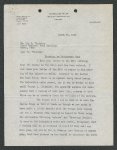
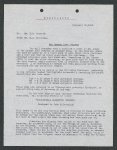
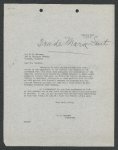
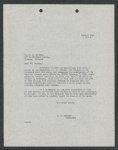
Show 3 2 specifications and drawings are still in the case as exhibits even if the rebuttal testimony of Luger is stricken out, and they clearly show that Luger and Browning have two sepa- rate specific constructions, both of which are dominated by Claim 1 of Luger, which forms the issue, apart from any testimony taken on behalf of Luger. In the Luger specification as filed, his invention is described, on page 11, commencing on line 12, as follows: ‘‘Now in accordance with the present invention the knee joint or toggle is cranked folded or opened while the barrel it might be formed on the forward lever—is extended laterally in one or preferably in both directions, beyond the arms of the forked shaped barrel casing B, thus forming studs, projections or shoulders which in the drawing are marked c’. “In the path of these studs or projections c* in the present example, suitable curved guide surfaces C* are provided on both sides of the handle piece, which when the barre! projections c* which by reason of their shape specification described, commencing on line 11 on file, his eamemeietemnbamienns CO Se Ne oS a Lhe POTTS Claim 1 of Luger was in his application as filed on March 17, 1900, but the similar claim of Browning was not inserted in his application until April 30, 1900, and not until he had been informed by the Patent Office that such a claim would be allowed to another party unless he wished for an interference. Browning, in his preliminary statement and testimony, undertakes to say that he conceived his invention in the year 1894, and the record of his application clearly shows that he did not seek to claim it until April 30, 1900, between five and six years after he says he conceived it, and “after the arrival of the other party on the field of ewvention.” The status of these contesting parties seems to be exactly decided by the Court of Appeals of the District of Columbia on April 4, 1899, and again upon a rehearing on December 6, 1899. ‘These two decisions are reported in PE SIR pK SAFSa te, ao te Browning open position, as shown in figure 9.” are termed ‘knee-eyes’ or ‘ link-eyes,’ so that, when a shot is fired, they the at the rear end thereof, in lifting up or humping up the links so as to carry the center of the pin J* above the centers of the pins I*° and J® after which the rearward momentum of the recoiling parts will force up or hump up the links with the effect of starting the breech-bolt back into its full the same as the contestants in Bechman vs. Wood, which was are by the effect of the recoil, moved upward and thus become the means of cranking or ‘opening’ the linked levers.” In upon its stud or recedes are impinged upon by the above-mentioned = : RII *: SESS RSLS tae SEE 1 BENTEs Lae seiertieaeinsiamniiniiamneace DOOR OMT EP OS T TRIE performs its rearward movement. “To this end the lever-eye knuckle or boss with which the knee-joint or toggle is provided—and which in the example shown forms part of the rear lever c’, though if desired “The forward end of the rear link is also formed lower face with a cam surface J® which co-acts with a rounded shoulder J°, formed on the non-recoiling receiver invention is of page 7, as follows - O. G., vol. 89, No. 12, dated December 19,1899. Attention is also called to the fact these two decision are based largely on a decision of the Supreme Court of the United States, Chicago vs. Northwestern Railway Co. vs. Sayles, 15 O. G., 243, and that this decision present case. also applies directly to the In this decision the Court said as follows: “The law does not permit enlargements of an original specification, which would interfere with inventors |