| OCR Text |
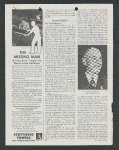
Show 8 Administration hopes that Midwest carn ers will sell enough corn from their 1944 crop to enable livestock raisers to secure adequate stocks of feed for the winter months. '- MANAGEMENT The Colt Mystery A prime mystery of World War II is Hartford’s famed Colt’s Patent Fire Arms Manufacturing Co. Colt, as the biggest of all prewar U.S. gunmakers, had a backlog of $30,000,000 in orders when war came. And stockholders remembered that in 1917 Colt had paid a fantastic $60 cash dividend, later tossing in a 1oo% stock dividend Colt to boot. But in March stockholders got another 1944, kind of shock. For the first time in 27 years, Colt year, while the highly skilled toolmakers made as little as $3,000 a year. Result: many workers drew big pay for little work, had no incentive to work harder, fearing rates would be cut if wages became too fantastic. Colt went through a series of small strikes. The War Labor Board spanked management as “largely responsible” for the wage mess. When WLB tried to even up wages by lowering some, raising others, Colt landed in a new mess over the cuts. Production slumped. In May Colt turned out only 31% of its scheduled number of .50-caliber machine guns, only 54% of its .45-caliber automatic pistols, only 55% of its .38-caliber automatics. Another Brewster? New President Anthony took his coat off and charged. He called in workers, warned them that if their production did not rise, they would be let paid no dividend. On April 20 came shock No. 2. Up to board chairman went Colt’s ailing president, Samuel M. Stone, who THE MISSING MAN He may have “caught” his illness in the washroom yo REALIZE what a serious hindrance illness is to war production when you stop to think that every day it keeps 1,200,000 men and women workers away from their jobs. That’s a yearly loss of nearly nine days per worker. And the illness rate goes up as the average age of workers increases. The causes remain much the same— half the illnesses are traceable to the com- mon cold and its complications. Such contagions can be spread—or checked—in your washrooms. , Sanitary washrooms, well equipped with soap, hot water and individual tissue towels are “health zones.’ They encourage thorough washing—and that cleans away the germs of contagion. For a complete check-up on your washroom facilities, call on the Scott Wash- room Advisory Service. It may be able to suggest Improvements and economies. The Scott Washroom Advisory Service shows how to make ScotTissue - Towels go farther If you use Scot Tissue Towels, it will help you make your supply go farther. That’s now of utmost importance. ‘For instance, our educational material reminds workers that one “‘Soft-Tuft”’ ScotTissue Towel dries completely .. . will absorb twice the water left on hands. And it has ten times the previous rub strength, though soft as ever. | Scott Paper Co., Chester, Pa. Trade Marks ‘‘ScotTissue,’’ **‘Soft-Tuff,’’ **Washroom Advisory Service’’ Reg. U.S. Pat. Off. SCOTTISSUE TOWELS — STAY TOUGH WHEN WET Thirsty Fibre 3 had driven Colt with a tight rein for 22 years. To the presidency came Graham H. Anthony, 52, a veteran Colt director. New Boss Anthony lost no time in letting out the biggest shocker of all: in the first 16 weeks of this year, Colt had managed to lose $1,100,580, had actually been in the red since June 1943. The big question: how could a gunmaker lose money in the greatest war in history? Get Out the Guns. By last week, harddriving President Anthony had some of the answers. He was hard at work to pull Colt out of its queer hole, if anyone could. Gunman Anthony, born in Shelby, N.C., graduated from North Carolina State Col- lege into a job in a machine shop. By the black days of 1932 he was president of Veeder-Root, Inc. (mechanical counting devices) in Hartford, Conn. Veeder-Root was on the downgrade, as were so many firms, and losing money. Anthony man- aged to stop the skid and make Veeder- Root profitable. He is still board chairman. His strategy to save Colt: “Get out the guns.” at WPA Colt at Work. But getting out the guns has long been hamstrung by a Coxtt’s ANTHONY “Get out the guns.” go. When production dawdled, Anthony roo-year-old handwork tradition. In trying to graft war production of 6,800 guns monthly onto peacetime artisan manufacture of 400 yearly, Colt fell into a fearful production tangle. Typical example: Colt numbered all barrels at the beginning of assembly, as they had always done, and fired some 42 workers. The next day production started up. By last week guns were coming out at the pre-slump level. But all this jiggery-pokery had boosted the price of Colt machine guns some 60% General Motors Haven’s High would Standard (Timer, Oct. 25), to whom Colt not test finished guns unless they above the price the U.S. Government pays and New came up. in sequence. Result: when one gun was pulled out because of a faulty part, the whole test line stopped. Quipped one worker: “Production was like a Rube Goldberg cartoon—everyone and _ his leased its patents and “know-how.” Already Anthony has made one price reduction. The swollen price netted Colt a profit ‘brother in line with those of other makers. was a foreman... . . Mobs walked through the plant all books and no one knew what of men day with they did. . « « Lt was like WPA.” Incentive Pay. But the deepest quag- mire for production was a fantastic incentive pay plan. Colt had always had incentive pay. When mass production came to Colt, it kept the same piecework rates as for the slow handwork. Thus semi- skilled filers came to earn as high as $8,200 82 of $1,010,196 1943 the last year. Army asked But Colt in October to cut prices Colt fell into the red. President Anthony frankly worries about how long the Army will buy Colt machine guns, when it can get them cheaper and faster elsewhere. The Army has held off mainly because Colt has done the experimental work for the Army on machine guns, and will still be making them in peacetime, when General Motors has gone back to autos. But President Anthony is TIME, JUNE 19, 1944 |