| OCR Text |
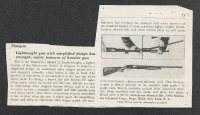
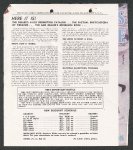
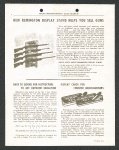
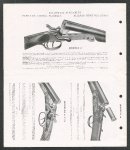
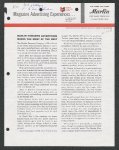
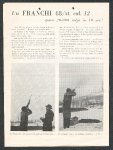
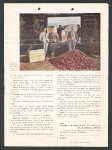
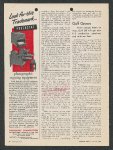
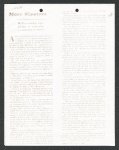
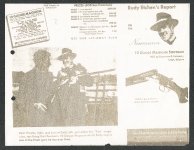
Show complaints about Remington’s —automatic shotgun fell into a pattern: “"T’oo heavy-too bulky—like carrying a crowbar.” Out of the redesign of this one gun came a redesign of the whole Remington line, lightening and standardizing all the shotguns and nifles in the company’s much-touted “Family of Guns.” Through machining studies Warden, the company developed new eutting methods that held closer were redesigned tolerances. Parts to to assembly of a variety of guns without slow and expensive hand filing, lapping, and fitting. Remington spent $22-million to carry out its new program. The results are dramatic. ‘Three years 7;500 major components were tied up in process for 23 days; today, only 750 parts are held in the cycle, which has itself been reduced to three photographic copying equipment You'll find this splendid equipment serving faithfully in insurance, commer- days. In Remington’s arms factory at Ilion, N. Y., gunstocks, receivers, actions, and barrels all go a long way along common production lines, di verge only for the modifications that make them either rifles or shotguns, then return to common lines for stock finishing, metal bluing, testing, and packaging. e Winchester Production—By contrast, Winchester’s design and production are guided by its belief that refinements, the extras that spell quality, must be included in a gun. “We use very few stampings,” says Hurley. “We make forgings and then machine them. We get a higher manu- cial and industrial concerns everywhere, facturing cost, sure, but we think it’s from the smallest to the largest . . . and also in federal, state, county and municipal offices, coast to coast. It sets the standard for economical, dependable photocopying the nation and the world over! If your requirements are small or the best way to make _a gun that a man_will keep a lifetime and then be proud to hand.down..to,his.son.”” Thus, for its model 50 automatic shotgun, introduced last year, Wiaunchester built a million-dollar production line solely for the manufacture moderate, it will serve you well. The PHOTOSTAT Instant Copier and Model Junior machines save time and money in any office, anywhere. Or, if need be, our larger automatic models will provide the answer to your copying problems. * Together with MICROTRONICS® Micro-film equipment . . . now manufactured by PHOTOSTAT CORPORATION . .. we provide the greatest variety of fine equipment available for copying and preserving records of all kinds on both paper and film. Let our trained sales-service representatives, coast to coast, advise and aid you. Your inquiries will receive our prompt and interested attention. Feel free to write us .. . no obligation! 295 STATE STREET, ROCHESTER 14, Service offices in mos? principal and in Toronto, Canada PHOTOSTAT YORK is the registered trade-mark of PHOTOSTAT 66 NEW cities Management CORPORATION of this gun: There’s little similarity among most Winchester guns, so most of the designs call for special parts and subassemblies. Winchester looks almost with horror on the couplings of rifles and shotguns sign. in a standard de- “Rifles and shotguns are not apples and oranges,’ says a Winchester designer. “They're not supposed to handle the same way.” e Results in the Field—Winchester never tires of pointing to the results of national championship rifle and shotgun matches, where it claims the fine points of manufacture show up most clearly. Manufacturers don’t make much money on fancy target arms and nothing extra on match ammunition, but the prestige is rated high. Winchester arms and ammunition Remington is now well dominate this field. Gulf Grows From led by eliminate many of the costly interior cutting operations, and to go into the ago, ‘this situation by introducing hot new competition loads and, just a few months ago, a radically new target rifle to challenge Winchester’s hold on this field. pretty acknowledging merger that’s on way, Gulf Oil will get new U.S. production, pipelines, and tank car fleet. Gulf Oil Corp. is getting set to buy up a pipeline system, a tank car fleet, and the natural gas and crude oil production of -in the U.S. 1.2-million acres of land To pick up these things, Gulf wants to buy Warren Petroleum Corp., Tulsa, Okla., in an exchange-of- stock deal. Reportedly, be exchanged most Warren stock will on a basis of 10 shares of Warren for eight shares of Gulf; but about 30% of Warren’s stock will be exchanged at the rate of 10 for 7.2 shares of Gulf. e No Wildcatter—Gulf, a large pro- ducer, has traditionally purchased its production holdings from other companies that explored them first instead of going in for heavy exploration on its own account. Since 58% of its present crude production comes from the Kuwait field in Arabia, Gulf will strengthen its U.S. production by picking up Warren Petroleum’s |.2-million acres. ‘The acquisition has other attractrons, too: For one, Warren’s natural gas production can be very useful to Goodrich-Gulf Chemicals, Inc., a petrochem1cal company of which Gulf owns 50%. Then, too, Gulf will gain from Warren’s extensive pipeline system and its fleet of 4,300 tank cars. Gulf, which has 11,000 miles of pipelines, strategically located refineries, and an extensive marketing system, expects to get plenty of advantage from Warren’s facilities. e Two Prices—The companies have not explained the background to the dual value exchange of stock, but here’s what seems to have occurred: Gulf ap- proached two shareholders, who _ between them held about 30% of War- ren’s common, with the 7.2 offer. They liked it and signed over their holdings. Thus armed, Gulf approached William Kelly Warren, Warren Petroleum’s founder, chief officer, and major owner (60% of common stock). Warren was amenable but held out for eight Gulf shares for 10 of Warren. W.K. Warren plans to stay on as his company’s chief officer, operate it im its present fields as a separate corporation. END BUSINESS WEEK e Nov. 19, 1955 |