| OCR Text |
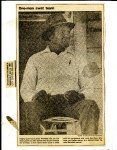
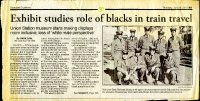
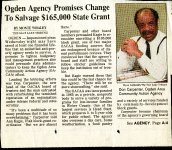
Show Po 40A Tuesday, February 24, 1998 Blacks Although he is one of only 32 blacks in a school of 2,000 students, he counts himself lucky. “I’ve got friends here,” he said. ‘““That’s why I go here instead of Weber High where there’s no blacks.” But even at Ben Lomond, black students feel the strain of living in a white world. A few like Tonika Gibson, who moved from Dallas 1 1/2 years ago, relish the idea of being From 1A Temple Church of God in Christ. “Church is where the heartbeat of the black community is.” The first blacks in Ogden came with the railroad. They worked as porters and waiters on the trains, settling in the area between Wall and Grant avenues. They quickly formed a community that created more than a dozen black churches between one of a few. Others like LaTonya Green are tired of the novelty. Ogden and Salt Lake City. While Ogden’s blacks worshiped separately, they lived much of their daily lives as part of the larger community. Even neighborhoods were rarely segregated, although blacks generally were not welcome east of Washington Boulevard until the 1970s. Dorothy Lee moved with her family from Rosebud, Texas, to a small home on Pingree Avenue more than 40 years ago. The house where she lived with her 11 brothers and sisters and parents still stands along a street of small homes. “On this side, there was a Spanish family,” she said. “On the other side, there was a white Today, the 32 students will put on an assembly in honor of Black History Month. They already know most white students won't get the point. “They just think it’s entertainment,” said Green. A remembrance Many will not even recognize - the name of Marshall White, Og- family.” She said she never experienced any racism. ”I grew up around white peo- ple,” she said. Most agree that Ogden blacks did not suffer the sort of discrimination that blacks in other states faced. True, they had to sit in the balcony when they went to the movies, but there were no distinct color lines like McAllister grew up with in Pine Bluff, Ark. In Utah, the discrimination was more polite, more subtle. Ina predominately LDS state, black men were barred until the late 1970s from holding the priesthood, one of the fundamental offices of the church. Black children attended white schools, but the integration ended at the social clubs. Sunset resident Betty Moore, 75, graduated from Ogden High School in 1940, the only black student in a class of 800. She had friends, she said. Yet, she didn’t. Unable to join the school’s social clubs, Moore had to go to Salt Lake City or church to meet other young people. Watkins, 52, went to school with Moore’s daughter. She too was not allowéd in social clubs. They were filled when she askea to join. Being one of a handful of black students also presented dating problems. “Back then you didn’t date (blacks and whites),” she said. A sanctuery one place kids and adults could find the social interaction many missed in school and at work. Although many blacks are now accepted in the larger coramunity and have long since left the inner city for the suburbs like . their white counterparts, many | return to the churches of their youth. “T think we'll always have seprate churches,” Watkins said. hur style of worsaip is ¢ ifferent. "1 not saying it’s more spiritual. . $more cemonst-ative. The cf *'ng_s ce $ dc 7 students +t area high Is canbe a of any cl he dead s: | itj livelier.” yell re; Sgcace 70 lon teenage 1963 by a Watkins was just 18 when she heard of her father’s death. He hadn’t started out to be a policeman. res “He was trained as a medical doctor,” she said. “But they wouldn’t let him practice here.” Ogden’s N ecame a policeman. Today, his memory lives on at the Marshall White Center, where young blacks go to socialize and learn about their heritage. Most don’t know their city sent Utah’s first black representa tive to the state Legislature. The Rev. Robert Harris later became an activist who protested inequality by lying down in the city’s streets. After numerous arrests, the police chief decided to put traffic cones around the reverend rather than take him to jail. But many of the-young biacks:— in Ogden know the struggle isn’t complete. Ogden High junior Jahmaal Sawyer is one of them. As president of the area’s youth NAACP, Sawyer follows in his mother Betty’s footsteps. She heads the local chapter of the National Association for the Advancement of Colored People. He believes that young blacks © need role models to inspire them. It was the dethronement of one such role model that recently fractured Ogden’s black community. H.C. Massey came to Ogden in the early 1970s. Soon, he was in charge of the Ogden Area Community Action Agency, which provided services to the area’s poor. Over time, the black community. came to view Massey and his agency as a symbol! of pride. Many felt his firing last year was a direct slap in the black cominunity’s face. The black churches were the © ee who in boy bent on escaping. Instead, the Sus president of Didn’t feel racism e den’s first black poe was killed "2 3 It didn’t help that the man _ who did the firing was also a black man who many know and respect. “T believe that if they didn’t ~ have Don Carpenter to open that € 3dr, it would never have gone a ywhere,” Sawyer said. Carpenter, a Webe State Uni_¢’sity professor, azte s. He also "++ ew what it would cc * him in ~ > comm nity when } .assey was “y But For. est Crawford, also a iU profi ssor, said it’s foolish bvclieve - vat the black cc jnmuis inviclate. Spi y t7.e ck \ |